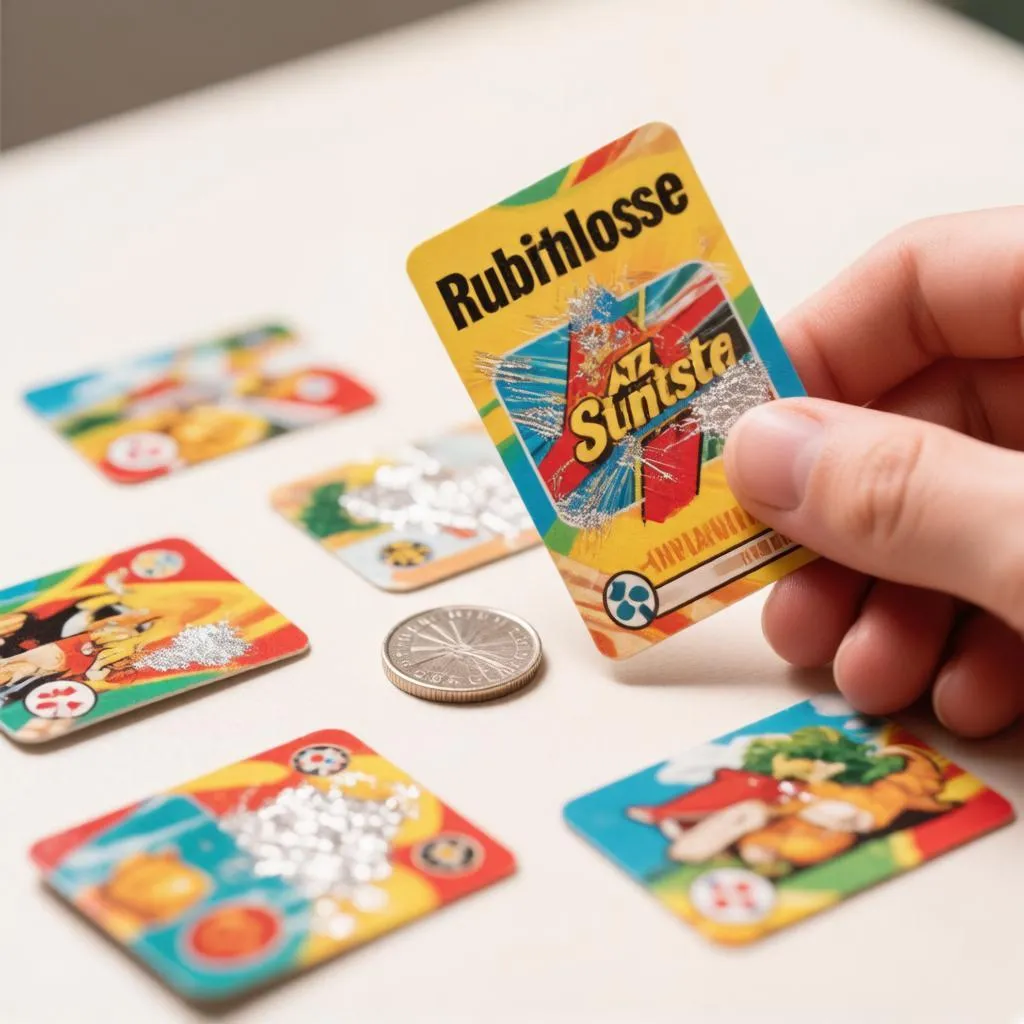
In Germany, instant games outsell almost every other form of lottery by sheer volume — hundreds of millions of Rubbellose are scratched every year, mostly on the way home from work, at a kiosk or in the queue at the supermarket till. The appeal is obvious: no waiting for a Saturday draw, no matching five numbers out of fifty, and a result you can see within thirty seconds. What most players never see, though, is the machinery behind the shiny silver film — how the prize distribution actually works, what the odds really are and which series are worth a second glance. Once you understand that, scratch cards stop being pure blind luck and become something closer to an informed choice.
What Rubbellose are and how they are organised
Rubbellose are instant lotteries: you buy a card, scratch off a coated film and find out immediately whether you have won. Unlike Lotto or Eurojackpot, there is no draw, no pool of millions of tickets across Europe and no rollover — every prize in a series is fixed and printed on the tickets themselves.
The organisation, however, is very German in its structure. There is no national scratch card company. Instead, each federal state runs its own lottery society — LOTTO Bayern, WestLotto in North Rhine-Westphalia, LOTTO Berlin, LOTTO Sachsen and so on — and these regional operators jointly commission the card series sold nationwide. The series designs, prices and top prizes are largely standardised across states, which is why a “7er-Klassiker” in Munich looks the same as one in Hamburg, even though the operator behind it differs.
Since the interstate gambling treaty came into force in 2021, licensed online sales have become legal as well, which has quietly changed the market: digital versions of popular series can now be played on official lottery websites and apps, with the result revealed by tapping instead of scratching.
The popular series and what they cost
German scratch cards come in a small range of well-defined price classes, and every class has its own character. Prices typically run from €1 for the simplest mini-cards up to €10 for premium series, with top prizes scaling accordingly — usually from a few thousand euros at the low end to €50,000 or more, and occasionally far higher in special editions.
| Series and price class | Typical price | Typical top prize | Approximate odds of any prize |
|---|---|---|---|
| Mini-cards (Glückspilz, seasonal small cards) | €1–€2 | up to about €25,000 | around 1 in 3.5 |
| Classic series (Arosa Line, 7er-Klassiker) | €3–€5 | about €30,000–€50,000 | around 1 in 3.5–4 |
| Premium series (Xtreme, GOLDRAUB, Pot d’Or) | €5–€10 | about €50,000–€100,000 | around 1 in 4 |
| Special and seasonal editions (Weihnachtslos, summer editions) | €3–€5 | up to about €50,000 | around 1 in 4 |
The figures above describe the general pattern rather than a guarantee: exact odds and top prizes are set individually for every series and every print run, and they differ slightly between federal states. What stays true across the board is the overall shape of the market — roughly one in three to one in four cards returns some kind of win, but the overwhelming majority of those wins are small prizes in the €5 to €50 range that simply cover part of your stake. The large top prizes exist, but only a handful of cards in each print run carry them, which is why scratch card wins worth talking about are as rare as they are memorable.
How to scratch a card properly
The physical process is self-explanatory, yet there is a small sequence to it that beginners often skip — and that sequence affects whether a prize is actually paid out. Follow it once and it becomes second nature:
- Check that the card is intact and the security film is unopened; damaged or pre-scratched tickets cannot be paid out.
- Read the rules printed on the back — each series has its own matching pattern, such as three identical symbols, a visible sum or a symbol comparison.
- Scratch the play area completely with a coin or a purpose-made scraper; a single coin left uncovered can make a winning card look like a loser.
- Look for the serial or ticket number and keep it intact — this is what identifies the card in a payout claim.
- Verify your result before throwing anything away: at retail points the terminal scans the barcode and confirms the prize on the spot, and online versions do the same with a single tap.
- Claim your win within the deadline set by your state lottery, which is typically several months after the series closes.
That last point deserves a pause. Prize claims are tied to the card series, not the calendar year, and once an operator officially closes a series, unclaimed winnings expire. Checking tickets before binning them is not paranoia — it is occasionally a five-figure habit.
Where to buy Rubbellose online
Buying online became genuinely practical only after the 2021 gambling treaty created a clear legal framework, and today there are two distinct routes. The first is playing through the official channels of the state lottery societies and their licensed online partners, where digital scratch cards mirror the retail series. The second is lottery agencies — commercial platforms that buy retail tickets on your behalf and scan them into your account. Before choosing, it helps to know what each option offers:
- Official lottery sites and apps — operators such as the national online platforms of the state societies sell digital versions of popular series, with automatic verification and payouts credited directly to your account.
- Licensed lottery agencies — services like Tipp24 and LOTTO24 buy physical tickets at retail for you, upload a scan and transfer any winnings electronically; you play the real card series, just remotely.
- Dedicated instant-game platforms — some state lottery portals additionally offer digital-only instant games with their own prize structures, which are separate from the classic retail Rubbellose.
- No third-party resellers — platforms without a German lottery licence fall outside the regulated market; winnings there are not backed by the state prize pool, and the age verification and player-protection rules do not apply.
The practical difference between the first two options is smaller than it looks. Both are licensed, both verify your age at registration and both pay out the same real prizes. The agency route gives you a scanned physical ticket and usually a small service fee; the official digital route gives you instant play and no paperwork at all. In both cases, the minimum age is 18 without exception — Germany takes that rule seriously, and every licensed platform checks it during registration.
Odds, return rates and the honest maths
Scratch card odds are easier to reason about than draw lotteries because the entire prize distribution is printed in the official game rules. Each series declares, for instance, how many of the twenty or thirty million printed cards carry a €10 prize, a €100 prize and so on, all the way up to the handful of top prizes. Nothing is random in the distribution itself — randomness only decides which card ends up in your hand.
The return rate is the honest anchor here. German Rubbellose typically pay out around 60 to 65 per cent of ticket sales as prizes, meaning the average player gets back roughly 60 cents for every euro spent over the long run. That is noticeably lower than the return of Lotto or Eurojackpot, and it is the price you pay for immediacy. The flip side is frequency: small wins arrive often enough that the game keeps its pace, and the whole experience is designed around short, cheap, self-contained excitement rather than a calculated bet.
Two practical consequences follow from this. First, the “chance of any prize” and the “chance of a worthwhile prize” are very different numbers — around one in three cards wins something, but only a vanishingly small share wins anything above the €500 mark. Second, price does not buy better odds of winning; it buys bigger potential prizes. A €5 card is not three times more likely to return your money than a €1 card — it is more likely to return a large sum if it wins at all.
Buying at a shop versus playing online
Both channels sell the same underlying series, but the experience around them differs in ways that matter more than most beginners expect. Retail cards are anonymous bearer tickets: whoever holds the card can claim the prize, so a winning ticket lost in a pocket is a prize lost forever. Online entries, by contrast, are tied to your account, verified automatically and paid out without a trip back to the kiosk where you bought them.
There is also a resale grey zone worth knowing about. Various websites offer “online scratch cards” that are actually games of chance run by their own operators rather than the official German series. Since the state holds a legal monopoly on lotteries with interregional scope, these are not the same thing as Rubbellose, and their prize pools are not the state-backed ones. If the goal is to play the real cards, stick to the licensed official channels and the recognised agencies.
Taxes, limits and the small print
Germany is friendly territory for lottery winners: winnings from licensed lotteries, including Rubbellose, are tax-free for private individuals. No percentage is skimmed off at payout, and even a six-figure scratch card win does not trigger income tax. The exceptions lie elsewhere — interest earned later on invested winnings is taxable like any other income, and professional gambling, which in practice almost nobody falls into, is treated differently.
Player protection rules apply uniformly. Beyond the age limit, licensed platforms let you set deposit limits, take cooling-off breaks or self-exclude, and retail operators are trained to refuse obviously problematic sales. The cards themselves also follow advertising rules that keep jackpot claims in proportion to real odds — a refreshing contrast with some unregulated online casinos.
Sensible habits for scratch card players
Scratch cards are entertainment with a fixed cost, and the players who enjoy them most are the ones who treat them exactly that way. A few habits keep the fun cheap and the illusions out:
- Set a fixed monthly budget for Rubbellose and never chase a loss with a bigger purchase; the odds do not improve, only the total spent does.
- Prefer complete series knowledge over feel — check the official prize distribution of a series before buying; some series simply have friendlier mid-range prize structures than others.
- Buy from retailers with high turnover if you play retail cards, since top prizes are scattered evenly through each print run and popular shops sell their allocations faster.
- Keep tickets until you have scanned or verified them, and never trust your eyes alone on an ambiguous pattern — the terminal is the only judge that counts.
- Stop the moment the game stops being fun; a scratch card is a thirty-second pleasure, not an investment plan.
The last habit is the one that quietly separates a casual player from a costly one. Every scratch card is a closed event with a known expected value, and no amount of buying, pattern-spotting or superstition changes it. The silver film holds no memory, and the machine that printed the cards made no promises.
A closing thought
Rubbellose occupy a peculiar niche in German gambling culture: they are small enough to be casual, formalised enough to be fully regulated, and predictable enough to be understood in an afternoon. Buy them where you like your coffee, scratch them slowly or instantly online, verify every result, and hold the odds at arm’s length — knowing exactly how slim they are is what makes the occasional win feel like a bonus rather than a birthright. The next card in the stack may be worth nothing, and it may be worth €50,000; the only thing it will certainly not be is a fair trade for the €5 you paid. Play with that number in mind, and the game stays exactly what it should be.