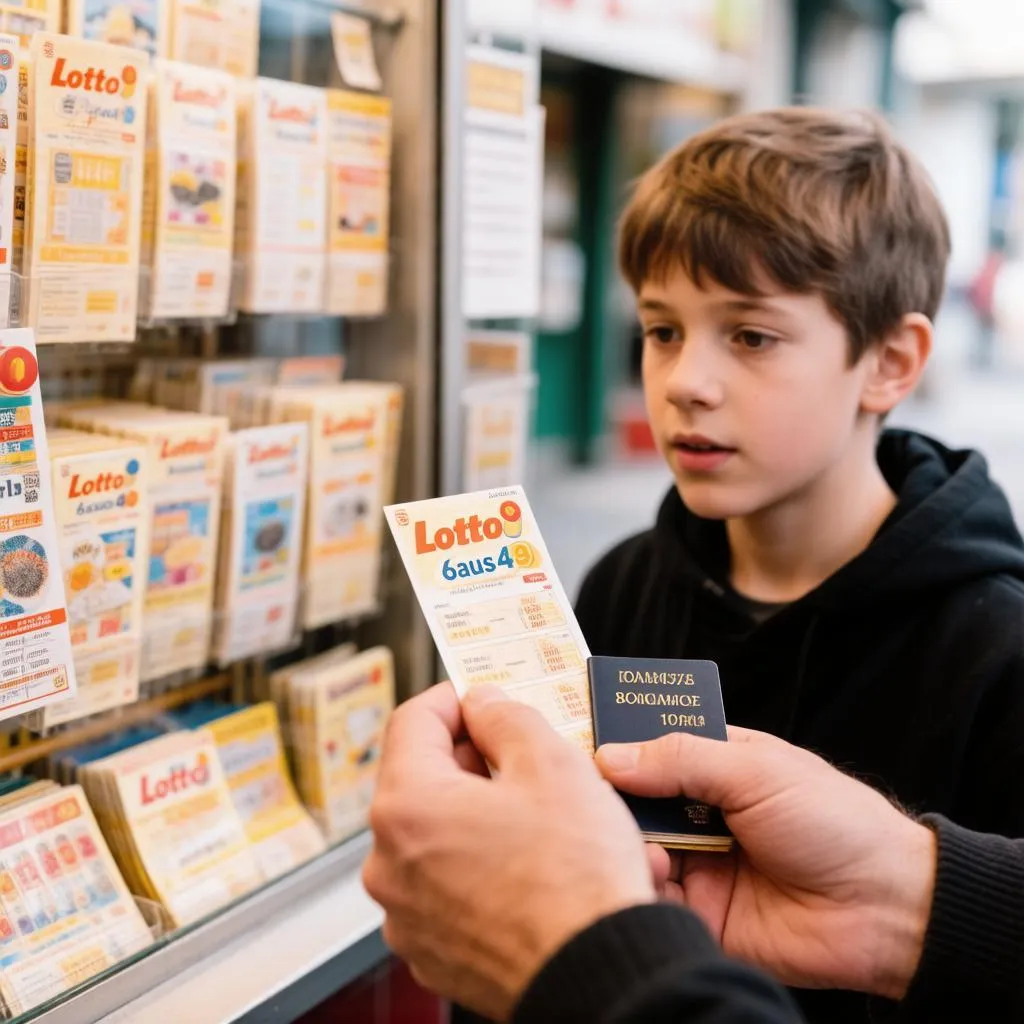
A teenager buys a €3 scratch card at the corner kiosk, the cashier barely glances up, and the transaction takes ten seconds. Did anything illegal just happen? For anyone who grew up with the image of lottery as a harmless, family-friendly game — the kind grandfathers fill in slips for at the kitchen table — the answer often comes as a surprise: yes, it did. Germany treats a Lotto ticket the same way it treats a beer or a pack of cigarettes, and the minimum age of 18 is enforced with real legal consequences. How the rule came about, which games it covers, how shops and online platforms actually verify age, and what happens when they fail to, form one of the least discussed corners of German gambling law.
The short answer
No one under 18 may legally participate in any form of gambling in Germany. That covers Lotto 6aus49, Eurojackpot, scratch cards, Toto, horse betting, casinos, poker and sports betting alike. A minor who buys a lottery ticket is not committing a crime personally — German law places the responsibility on the seller, not the buyer — but the purchase itself has no legal effect, and any winnings a minor collected could in principle be reclaimed. The rule is national, uniform and, since the gambling treaty reform, without exceptions for any product.
Where the rule comes from
The modern framework rests on two pillars. The Interstate Treaty on Gambling, which was comprehensively rewritten with effect from October 2021, harmonised the minimum age across all participating federal states at 18 for every type of gambling. Before that reform, the picture was patchier: different states had different traditions, and certain products were in practice available to younger customers in some regions while forbidden in others. The 2021 treaty swept those regional quirks away.
The second pillar is the Protection of Minors Act, the same law that governs alcohol, tobacco and media content for young people. It classifies commercial gambling as an activity that endangers minors by its nature — a legal assessment shared by most modern jurisdictions — and backs the age limit with enforcement powers. Together, the two laws leave no room for interpretation: the kiosk, the supermarket till, the betting shop and the online lottery platform all operate under the same number, and it is 18.
Which products the age limit covers
Because the treaty applies to “participation in gambling” as a category rather than to individual games, the list of affected products is longer than newcomers expect. It includes, among others:
- Classic lottery games — Lotto 6aus49, Eurojackpot, Spiel 77, Super 6 and GlücksSpirale, whether bought at retail or online.
- Instant games — all Rubbellose series, digital scratch cards included, which fall under the same rule despite their low price.
- Sports and horse betting — including small-stakes bets placed through betting terminals and apps.
- Casino games and poker — both land-based and online, with 18 as the minimum across all states.
- Amusement machines with prizes — slot-style machines in arcades and betting shops are covered by the same minimum age.
The uniform age of 18 is worth pausing on, because it changed in recent memory. Not long ago, a 16-year-old could legally buy a scratch card or place a bet on a football match in parts of Germany, which is why older articles and forums still mention the figure. The 2021 reform closed that gap deliberately: the argument was that the biological and psychological susceptibility to gambling addiction does not depend on whether the game is a draw lottery or a slot machine.
How age is actually verified
A rule is only as strong as its enforcement, and German gambling law takes the enforcement side seriously. Retail and online channels each use their own mechanisms, and the obligations sit squarely on the operators:
- Spontaneous visual checks at retail — staff must request an identity document whenever there is any doubt about age; a young-looking customer with no ID should be refused, and licensed retailers are trained accordingly.
- Mandatory registration online — every licensed lottery and betting platform verifies identity at account creation, combining a German ID or passport check, address confirmation and often bank account verification.
- Monitoring and mystery shopping — state gambling authorities and youth protection bodies send test buyers into shops; repeated failures lead to warnings, and in serious cases to the loss of the lottery licence.
- Documentation duties — retailers must be able to show they trained their staff on the rules; ignorance of the law is not accepted as a defence.
The online side is, ironically, the harder border to cross. A determined teenager can occasionally talk their way past a distracted cashier, but a digital registration that requires a passport scan, a verified German address and a bank account in the player’s own name is nearly impossible to fake. This is one of the arguments regulators themselves made for the 2021 reform: a controlled legal online market protects minors far better than a black market of unlicensed sites ever could.
What happens if the rule is broken
Responsibility for compliance falls almost entirely on the seller. Selling a lottery product to a minor is an administrative offence that can result in fines, and for licensed operators it is one of the gravest violations possible — gambling authorities treat youth protection failures as grounds for revoking a licence outright. Parents who buy tickets for their children sit in a grey zone: gifting a scratch card at Christmas is a widespread social habit, but legally the minor who scratches it is participating in gambling, and any “win” of a significant prize could be contested. In practice, small family gifts are tolerated socially, yet nobody should mistake the habit for legality — and no licensed operator will ever pay out a claim from a minor.
Why 18, and not 16 or 21
The choice of 18 was not arbitrary. It aligns gambling with the existing age thresholds for alcohol, tobacco and adult media, giving German law a single, teachable boundary: adult products end at the same line. Public health research adds its own logic — the younger the first contact with gambling, the higher the statistical risk of developing problematic habits later, a correlation documented across European countries. Low-entry-price products such as €1 scratch cards were a specific focus of the reform debate, precisely because their cheapness made them the most accessible entry point for teenagers.
How Germany compares internationally
Germany sits in the middle of the international spectrum, and placing it next to its neighbours makes the national choice easier to understand:
| Country | Minimum age for lotteries | Notes |
|---|---|---|
| Germany | 18 | Uniform for all games since the 2021 treaty |
| United Kingdom | 18 | Lowered from 16 for the National Lottery in 2021 |
| France | 18 | Raised from 16 for lotteries in 2016 |
| Austria | 18 | 16 permitted for some products historically |
| Netherlands | 18 | Strict identity checks online and offline |
| Some US states | 18 or 21 | 21 in states with casino-linked lottery |
The direction of travel across Europe is unmistakable: countries have been raising their limits, not lowering them, and the United Kingdom’s 2021 change — the same year as Germany’s harmonisation — moved the two systems closer still. The era of 16-year-olds legally scratching cards is over almost everywhere in Western Europe.
What parents and young people should know
The law draws its line clearly, but family reality is messier, and a few practical points are worth keeping in mind:
- Gifting tickets to minors is not harmless by default. A scratch card in a birthday card normalises the product for a child, and a prize attached to it creates a legal and practical tangle.
- Refusal at the till is the law working, not rudeness. Cashiers who ask for ID are following their training, and a refusal without ID is the expected outcome.
- Online platforms cannot be circumvented by age lies. Licensed operators cross-check identity, address and payment details, and accounts that fail verification are frozen.
- Unlicensed foreign sites are the real risk zone. They apply no German youth protection at all, which is precisely why steering young people towards understanding the legal framework matters more than the formal prohibition itself.
Read together, these points describe a system that works by layering: the law sets the limit, the operators enforce it, and the family handles the part the law cannot reach — attitudes. Countries where gambling developed quietly into an everyday habit among teenagers have, without exception, ended up walking the same path Germany took in 2021.
A boundary with a purpose
The answer to the question in the title is a clean, documented no: minors cannot legally play the lottery in Germany, and the number 18 applies to every ticket, every scratch card and every online entry in the country. Behind that single digit stands a deliberate legislative choice, backed by health research, enforced by licensing authorities and aligned with the rest of Germany’s age-related law. For a country that treats its lottery as a national pastime, the rule is less a restriction than a statement of what the game is supposed to be — an adult pastime with a fixed cost and an honest price tag, opened only once the player is grown enough to read the small print.