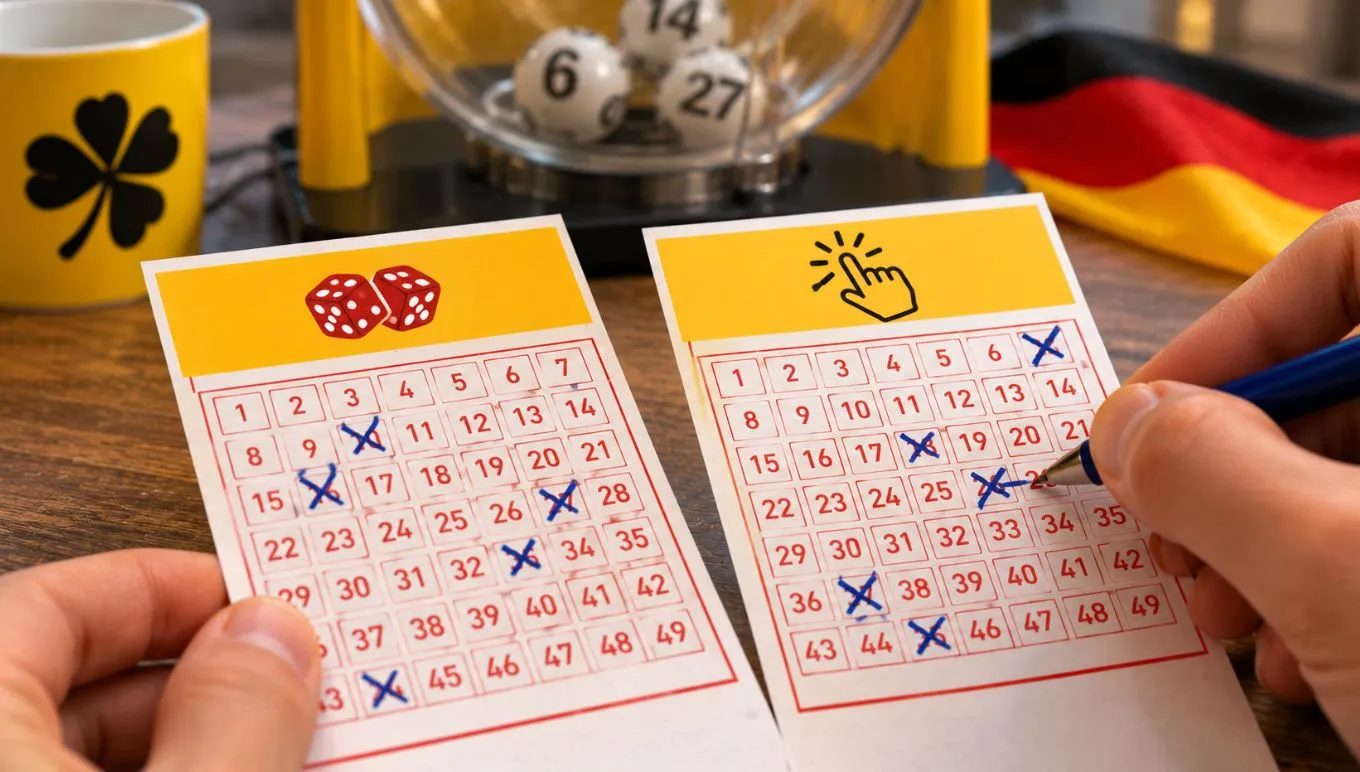
Standing at the Lotto counter in Germany, you face the same choice millions of players make every week: fill out the play slip yourself or simply say “Quicktipp, please.” The word literally means a quick tip, and it produces six random numbers between 1 and 49 plus a Superzahl — no thinking required. Yet behind this tiny decision sits a genuinely interesting question. Does the machine know something you do not? Does picking your own numbers change anything at all? And if the odds are identical, why do players care so much? The honest answers are surprising in places, and they matter more for how you experience the game than for whether you win it.
What a Quicktipp actually is
The Quicktipp is Germany’s standard method of letting the lottery terminal choose your numbers. You mark a box on the Tippschein — the play slip — or click a button online, and a random number generator selects six main numbers and assigns one of the seven Superzahlen. The draw itself is mechanically separate: German lottery drawings happen on air, with numbered balls tumbling in a drum, completely disconnected from whatever algorithm generated your tip.
This separation is the key technical fact. The generator that picks your numbers and the drawing machine that picks the winning numbers are independent random processes. Nothing in the terminal “knows” the upcoming result, and no algorithm anywhere is trying to predict or avoid it. A Quicktipp is not a hint from the machine, a pattern or a service — it is simply six numbers with exactly the same mathematical properties as any other six numbers.
A related feature hides in the same word. A “Quicktwertung” — sometimes confused with Quicktipp — is something different entirely: it is an automatic result check of a manually filled slip, telling you immediately whether your own numbers won. Players who keep their slips in a drawer for weeks can hand them over for a Quicktwertung at any acceptance point, and it costs nothing. One is a way of choosing numbers, the other is a way of checking them.
Why the odds are identical, no matter what
The mathematics of Lotto 6aus49 allows no escape: every combination of six numbers out of 49 has exactly the same probability, roughly one in 13.98 million. The numbers 1, 2, 3, 4, 5, 6 with Superzahl 3 are precisely as likely as 4, 17, 23, 31, 38, 44 with Superzahl 7. Intuition protests at this, because the first combination looks “special,” but the drawing drum has no aesthetics. Manual selection and Quicktipp therefore produce tickets of exactly equal winning probability — full stop, with no exceptions, systems or tricks changing it.
What manual selection does change is something subtler: the composition of the prize if you win. Human-chosen numbers cluster heavily around dates, ages and sequences, which means millions of players concentrate on numbers 1 through 31. When a draw produces low, date-shaped numbers, many winners share the same pool and each receives less. A Quicktipp, being indifferent to human psychology, spreads across the full 49 numbers and lands on unpopular combinations more often. Identical odds to win, different odds to win big — this is the real asymmetry between the two methods.
How the two methods compare in practice
Since the draw treats both tickets equally, the meaningful comparison runs through everything else: convenience, cost of your time, social coverage, prize sharing and sheer enjoyment of the game. The following comparison gathers the practical differences players actually notice week after week:
| Aspect | Quicktipp (random numbers) | Manual selection (own numbers) |
|---|---|---|
| Time per slip | Seconds — one click or one box | Minutes of choosing and checking |
| Winning probability | Identical to every other ticket | Identical to every other ticket |
| Number distribution | Spread across the full field | Concentrated on dates and favourite digits |
| Prize sharing on a win | Tends toward fewer co-winners | Higher risk of splitting with a crowd |
| Emotional attachment | Low — numbers feel anonymous | High — numbers carry personal meaning |
| Coverage of draws | Easy to keep playing regularly | Easier to forget or postpone |
| Suitability for Dauerschein | Ideal for subscriptions | Works, but requires updating decisions |
Read as a whole, the comparison shows why experienced players rarely treat this as a purity question. The random tip wins time and reduces prize sharing; the manual tip buys engagement and ritual. Both are rational choices depending on what you want from the game, and many players simply alternate between them.
The strongest arguments for each side
Choosing between the methods becomes easier once you see the cases for both laid out plainly. Neither is objectively superior — they optimise for different things:
- Quicktipp saves time and decisions. For weekly play, subscriptions and busy schedules, removing the number-picking step keeps the habit alive. Players who would skip a week while deliberating still submit their tip on time.
- Quicktipp avoids psychological traps. No combination feels “owed” a win, so losses carry less frustration, and there is no temptation to change systems after every draw.
- Quicktipp statistically reduces shared jackpots. Random numbers avoid the crowded low-number territory where date-players cluster, which matters whenever a win does occur.
- Manual selection makes the game personal. Birthdays, anniversaries and family ages turn abstract odds into a weekly ritual with faces behind the numbers, and many players value exactly this.
- Manual selection gives a feeling of control. The sense of having chosen is part of the fun for some players, even knowing it changes nothing mathematically.
- Manual selection enables deliberate syndicate strategies. A Tippgemeinschaft can split fixed numbers across members and vary the Superzahl, which some groups organise around.
Notice what is absent from both lists: any claim about winning more often. That claim does not exist in either direction, and any source promising that random or personal numbers improve the odds is describing fiction. The genuine differences are those of experience, not of probability.
Where the dates fall short — and what players overlook
The classic manual tip built from birthdays and anniversaries has a hidden cost that surfaces only on winning day. Because numbers above 31 are almost never birthdays, roughly a third of the possible main numbers appear in date-based tips only rarely, while the low numbers are massively overcrowded. When a draw produces 5, 11, 13, 19, 22, 28, hundreds of players hold matching tickets and the second prize class dissolves into dozens of shared amounts. Draws with several high numbers — 35, 41, 47 — repeatedly produce historically small winner groups with correspondingly large individual payouts, and Quicktipps were overrepresented among those winning tickets.
There is a middle path for players who want personal numbers without the crowding: build a tip from meaningful dates but deliberately push a few fields above 31, or combine one manually chosen field with five random ones. This keeps the personal connection while stepping off the most crowded real estate in the number field. It is a comfort strategy, not an odds strategy — but comfort is a legitimate part of the game.
How to use the Quicktipp well
The random tip rewards players who treat it as a tool rather than a spell. A few habits get the most out of it, and they cost nothing:
- Use it consistently with a Dauerschein. Letting the system re-randomise every draw keeps your coverage of the number field broad over months, which no fixed personal tip can match.
- Quicktip only what you cannot improve. For syndicates and system slips, random fills for empty fields save time without hurting the chosen core.
- Never re-quicktip to “chase” a feeling. Rejection and regret after seeing drawn numbers are psychological noise; the second random tip is no closer to winning than the first.
- Check results the same evening anyway. Quick or manual, an unchecked tip is the most common way Germans lose winnings to expired claim windows — 13 weeks for Lotto 6aus49, five for Eurojackpot.
The fourth point deserves the emphasis it gets. Players assume that a random tip somehow gets checked for them, which is true only online, where results are verified automatically. At the kiosk, a Quicktipp slip waits in your pocket like any other slip — and like any other slip, it expires silently.
Quicktipp versus the winning stories
Every few years German media report on a big win and ask the winner how the numbers were chosen, and the answers split almost exactly down the middle: roughly half report quicktips, the rest their own numbers, birthdays or a hybrid. The split mirrors the market share of the two methods — which is precisely what the mathematics predicts. No method accumulates a statistical advantage over years of play, and famous cases cut both ways: there are jackpot winners who played the same personal numbers for decades, and winners who bought a random tip on a whim at a motorway service station.
What the stories do reveal is that persistence, not method, separates players who win from players who do not — because you cannot win a draw you never entered. The method that keeps you playing comfortably and affordably is, for that reason alone, the best method for you.
Making your own choice
If you want the shortest honest conclusion: Quicktipp and manual selection are mathematically twins, experientially opposites. The random tip is faster, more even across the number field and friendlier to subscriptions and shared jackpots; the manual tip is personal, ritualistic and no worse in any way that matters to the drum. Try both for a month — a few Quicktipps on a subscription, a hand-filled slip with the family numbers — and the question will answer itself through habit rather than theory. Whichever you choose, sign the slip, keep it safe and check the results on draw night, because in German lotto the numbers that decide your luck are the ones that survive until payout.