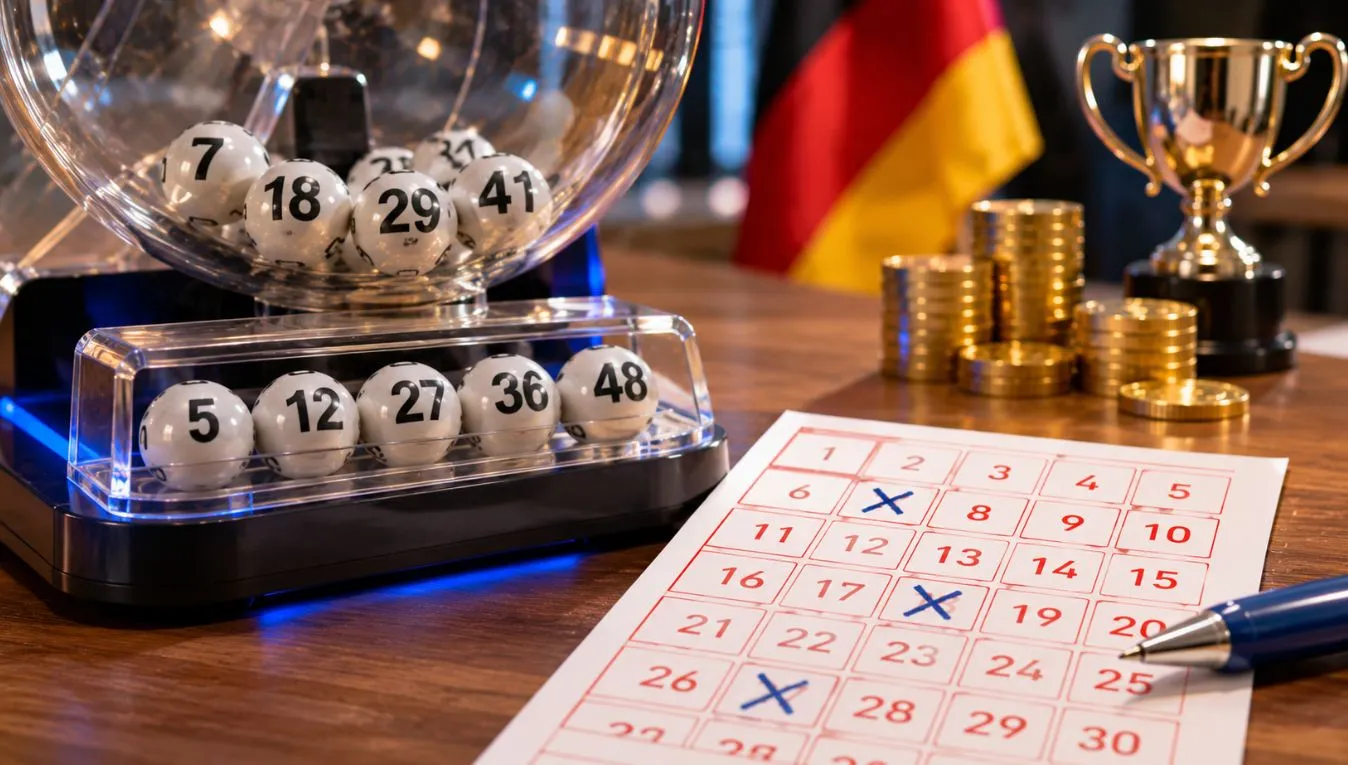
While Lotto 6aus49 and Eurojackpot dominate the headlines, Germany’s quiet daily workhorse runs every single day of the year: KENO, the numbers lottery of the German Lotto and Totoblock, drawn each evening with fixed prizes and no jackpot cycling. Attached to it is Plus5, a small end-digit lottery that costs less than a euro and pays out fixed amounts on a published table. Together they form the most frequent — and in some ways most transparent — lottery format in Germany, yet many players have never looked closely at how the game actually pays. Understanding the mechanics, the stake levels and the prize structure is genuinely useful here, because KENO behaves differently from every other German lottery in several surprising ways.
What KENO is and how the draw works
KENO is a daily numbers lottery offered by the sixteen state lottery companies. Every day, twenty winning numbers are drawn from a pool of seventy — a far larger draw than the six-out-of-49 format of Lotto, and the reason the game plays so differently. Before each draw, you choose how many numbers to play: anywhere from two to ten, and this choice defines your KENO type, which in turn fixes your prize plan and your odds. The more numbers you play, the more matches are possible — and the richer the prize table becomes.
The draw itself takes place once a day, every day of the year, in the drawing studio of the Hessian Broadcasting Corporation in Wiesbaden, alongside the Plus5 draw. Results are published in the evening, and by around 8 pm you can already check your slip. Submissions must reach the lottery centre before the daily sales deadline — typically 18:45 — which makes KENO the fastest-cycling game in the German lottery portfolio: a tip is never more than 24 hours away from its result.
The stake levels and what they change
KENO prices follow a logic of its own. Instead of a fixed per-field stake like Lotto, you choose one of four stake levels for each tip — 1, 2, 5 or 10 euro per number played — and the entire prize plan scales with your choice. A Type 10 tip at 1 euro stake pays 100,000 euro for a perfect match; the same tip at 10 euro stake pays exactly ten times that, a full million. Nothing about the odds changes with the stake — only the payout multiples.
The stake level also multiplies the small prizes, which is where KENO’s character shows. A Type 10 player who hits exactly five of their ten numbers collects 2 euro at the 1-euro level and 20 euro at the 10-euro level — the same relative return, different absolute comfort. Because the quotas are fixed and published in advance, every tip’s potential outcome is known before you submit it: there is no pool, no sharing calculation and no rollover anywhere in the game, with one narrow exception described below.
On top of the stake comes the familiar processing fee for submitting the play slip — charged once per slip by the state lottery company, typically between 25 and 60 cents depending on your federal state. The Plus5 option is priced separately at 75 cents per draw and, notably, carries no processing fee of its own.
How a KENO play comes together
Filling out a KENO slip is a three-decision exercise, and each decision shapes the price and the outcome. The sequence at the counter or online looks like this:
- Choose your KENO type. Decide how many numbers to play — 2 to 10. The type locks in your prize plan and odds for this tip.
- Set the stake level. Pick 1, 2, 5 or 10 euro per tip. The level scales every prize amount in your plan by the same factor.
- Select the numbers. Mark your numbers from 1 to 70, or let the terminal generate a random tip; the Quicktipp works here just as it does in Lotto.
- Add Plus5 if you want it. Tick the Plus5 box to include the 75-cent side game, which plays automatically with your slip’s serial number.
- Submit before the deadline. Hand in the slip before roughly 18:45 on the day of the draw; later submissions join the next day’s draw.
- Check the results the same evening. The twenty drawn numbers and the Plus5 winning number are published shortly after the draw, and registered online accounts check automatically.
Once the routine settles in, KENO becomes the lowest-maintenance lottery in Germany: same numbers, same stake, same result every evening — or a Dauerschein subscription that repeats the tip for you across any number of days, with the fee charged once for the whole period.
The prize structure: KENO type 10 as an example
Every KENO type has its own published prize plan, and the Type 10 plan — the one behind the million-euro maximum — shows the game’s architecture best. Reading it reveals an unusual feature: unlike Lotto, KENO pays even for zero matches at the larger types, and the odds for every class are fixed rather than floating.
| Matches | Prize at 1 euro stake | Prize at 10 euro stake | Odds of that class |
|---|---|---|---|
| 10 of 10 | 100,000 euro | 1,000,000 euro | 1 in 2,147,181 |
| 9 of 10 | 1,000 euro | 10,000 euro | 1 in 47,238 |
| 8 of 10 | 100 euro | 1,000 euro | 1 in 2,571 |
| 7 of 10 | 15 euro | 150 euro | 1 in 261 |
| 6 of 10 | 5 euro | 50 euro | 1 in 44 |
| 5 of 10 | 2 euro | 20 euro | 1 in 12 |
| 0 of 10 | 2 euro | 20 euro | 1 in 39 |
Two things in this prize plan stand out immediately. The chance of ten correct numbers — about one in 2.1 million — is dramatically better than the roughly one in 140 million of a Lotto six-win, which is precisely why the maximum prize is capped at a fixed million rather than growing into jackpots. And the zero-matches row is not a typo: with Type 10, nine and eight, a slip that misses every single drawn number still pays, because the mathematical probability of such a total miss is itself small enough to reward. Smaller types follow the same fixed-quota logic with scaled-down tables — a Type 5 tip, for example, pays 1,000 euro at the 10-euro stake for a full house, while a Type 2 tip pays 60 euro for both numbers correct.
One structural rule protects the company rather than the players: if more than five players achieve ten hits in Type 10, or more than ten players achieve nine hits in Type 9 on the same day, special reduced-payout rules from the participation conditions apply. In everyday terms this almost never triggers, but it is the only crack in KENO’s otherwise absolute promise of fixed prizes.
Plus5: the end-digit lottery attached to KENO
Plus5 is not a number game in the usual sense — it is a five-digit end-number lottery, the same family as Spiel 77 and Super 6, and it can only be played in combination with a KENO slip. Your participation number on the slip doubles as your Plus5 number: a five-digit sequence either assigned by the terminal or, when playing online, chosen by you. After each KENO draw, the lottery draws one five-digit winning number, and your result depends on how many trailing digits match — counted from right to left.
The prize table is fixed, small-scale and remarkably frequent by lottery standards:
- Five correct end digits — 5,000 euro, with odds of one in 100,000.
- Four correct end digits — 500 euro, with odds of one in 11,111.
- Three correct end digits — 50 euro, with odds of one in 1,111.
- Two correct end digits — 5 euro, with odds of one in 111.
- One correct end digit — 2 euro, with odds of one in 11.
The one-in-eleven chance for the smallest class deserves a moment of attention: roughly one Plus5 tip in eleven collects 2 euro, which is why long-term KENO players treat the 75-cent option as a steady drip of small returns rather than a lottery ticket in the classic sense. The five-digit maximum of 5,000 euro keeps the game modest — nobody builds a retirement plan on Plus5 — but as an add-on that costs less than a euro and never carries its own processing fee, it rounds out the daily format neatly.
The quirks that set KENO apart
Compared with Lotto and Eurojackpot, KENO behaves by different rules in several ways that regularly surprise players who switch between the games. Knowing them in advance prevents both disappointment and pleasant confusion:
- Draws every day, including weekends. No waiting for Wednesday and Saturday — every tip resolves within 24 hours.
- Fixed prizes instead of jackpots. The million-euro maximum never rolls over and never grows; the trade-off is dramatically better odds per class.
- Wins even with zero matches for the larger types, a feature unique among German lotteries.
- Age verification at the counter. Because KENO is classified as a higher-risk game for player protection, acceptance points require a registered customer card for kiosk play — online accounts verify age during registration.
- Tax-free winnings. As with all German state lotteries, private players pay no tax on KENO or Plus5 prizes, regardless of size.
These characteristics make KENO the most regular and the most controllable game in the German line-up — a daily ritual with known stakes, known odds and known payouts, rather than a hunt for a jackpot that keeps escaping.
Claiming your winnings
The payout process follows the standard German lottery rules, scaled to the modest prize amounts involved. Small winnings are collected directly at the acceptance point against the play receipt, while larger amounts go through the central claim form and bank transfer — and the usual deadline discipline applies:
- Prizes remain claimable for 13 weeks after the draw, the same window as Lotto 6aus49, so an unchecked daily slip still expires silently.
- Online winnings flow automatically to the registered player account, typically within two to five working days, with automatic transfer thresholds configurable in the account settings.
- The claim follows the original slip, which makes keeping the receipt — or playing electronically — just as important here as in the big jackpot games.
Because most KENO prizes are small, the practical experience is refreshingly uncomplicated: check the evening results, collect at the counter the next day or let the online account credit you, and the transaction is over. The 13-week window still matters for players who skip weeks of checking, since a forgotten winning slip is the most common way KENO money goes unclaimed.
Who KENO and Plus5 actually suit
A game with daily draws, fixed quotas and a capped maximum answers different needs than Lotto or Eurojackpot, and the fit depends on what you want from play. KENO rewards players who value rhythm and transparency over the dream of a life-changing sum: the stakes are predictable, the outcomes resolve fast, and the prize table never hides surprises. Players who chase seven-figure jackpots will find the fixed million a ceiling rather than a lure — for them, the big draw games remain the right stage.
For everyone else, the combination works like this: a KENO type between four and eight at a comfortable stake level delivers frequent small and medium wins that keep the daily ritual engaging, while the Plus5 add-on adds a cheap second chance with a one-in-eleven floor. The costs stay visible and controllable — 1 to 10 euro per tip, 75 cents for Plus5, the state fee per slip — and nothing about the game is opaque. In a lottery landscape built around postponed gratification, KENO Plus 5 is the daily version: modest, fast, honest about its numbers, and drawn every single evening for anyone who prefers their lottery in small, regular doses.